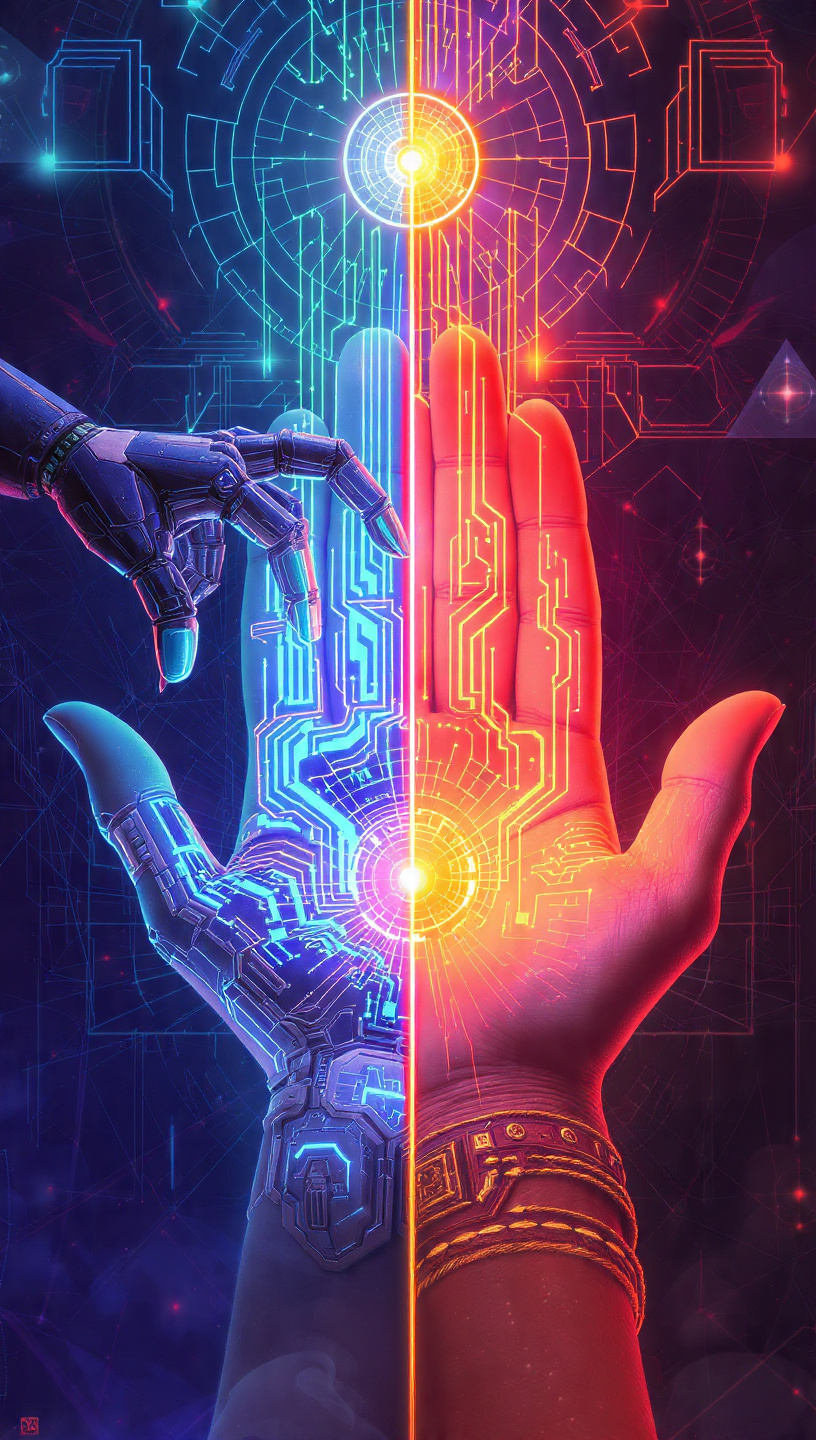
Is AI Palmistry Better Than Traditional Palm Readers? A Deep Comparison for the Digital Age
Blog Author
5 min read
2/19/20262
AI palm reading
digital palmistry
online palm reader
palmistry accuracy
AI astrology
Is AI palmistry more accurate than traditional palm readers? Discover the differences, benefits, limitations, and future of AI-based palm reading in this detailed guide.
Palmistry has fascinated humanity for centuries. From ancient spiritual traditions to modern digital apps, the art of reading palm lines continues to evolve. Today, a new question is gaining popularity:
Is AI palmistry better than traditional palm readers?
With artificial intelligence entering astrology and spiritual sciences, many people are curious whether machines can truly interpret destiny better than experienced human readers.
Let’s explore both sides in detail.
What Is Traditional Palmistry?
Traditional palmistry is the ancient practice of analysing hand lines, mounts, shapes, and finger structures to predict personality traits, career paths, relationships, and life events.
It has roots in:
Ancient Indian traditions (Samudrika Shastra)
Chinese hand reading practices
Greek interpretations influenced by Aristotle
A skilled palm reader studies:
Heart line
Head line
Life line
Fate line
Mounts (Venus, Saturn, Jupiter, etc.)
Hand shape and thumb position
The interpretation often depends on experience, intuition, spiritual belief, and observation.
What Is AI Palmistry?
AI palmistry uses artificial intelligence and machine learning to analyse images of your palm. Users upload a photo, and the system scans:
Line depth
Line curvature
Breaks and islands
Mount prominence
Symmetry patterns
The algorithm compares your palm structure with thousands (sometimes millions) of stored patterns to generate predictions.
AI systems rely on:
Image recognition technology
Pattern detection algorithms
Statistical modeling
Data-driven analysis
Unlike traditional readers, AI does not rely on intuition or spiritual interpretation. It relies on data.
Key Differences Between AI and Traditional Palm Readers
- Accuracy
Traditional Palm Readers
Accuracy depends on experience.
Emotional connection may influence interpretation.
Two readers may give different predictions.
AI Palmistry
Consistent pattern-based analysis.
No emotional bias.
Same input = same output.
However, AI is limited to programmed knowledge. It cannot interpret subtle emotional cues.
- Personalisation
Traditional readers can:
Ask questions
Adjust predictions based on life context
Offer emotional support
AI systems:
Provide automated reports
Lack deep emotional conversation
Cannot adapt unless programmed for interaction
For users who want counselling-like guidance, human readers may feel more supportive.
- Accessibility
AI wins clearly in this category.
Available 24/7
Accessible from anywhere
Affordable or free
Instant results
Traditional palm readers:
Require appointments
Can be expensive
May not be available in all locations
For modern users, convenience matters.
- Privacy
Some people feel uncomfortable sharing personal details face-to-face.
AI offers:
Anonymous readings
No judgment
Private digital reports
However, users must ensure the platform protects image data and does not misuse palm images.
- Speed
Traditional reading: 20–45 minutes
AI reading: 10–30 seconds
For quick insights, AI is far faster.
Can AI Truly Understand Destiny?
This is where debate begins.
Palmistry is not just about line measurement. Traditional practitioners believe:
Energy flows through the body.
Intuition matters.
Spiritual insight plays a role.
AI does not understand energy, karma, or spiritual vibration. It understands patterns and probability.
So the question becomes:
Is palmistry a spiritual science or pattern science?
If it is pattern-based, AI may perform well.
If it is intuition-based, humans may remain superior.
The Psychological Factor
Human palm readers:
Read facial expressions
Observe tone of voice
Sense emotional reactions
Adjust language accordingly
AI:
Cannot detect emotional states (unless integrated with advanced behavioural systems)
Gives structured responses
Many people visit palm readers for reassurance, not just predictions. Emotional comfort plays a major role in perceived accuracy.
Can AI Reduce Superstition?
Interestingly, AI palmistry can bring structure and reduce fear-based interpretations.
Some traditional readers:
Overemphasize negative signs
Predict extreme outcomes
Create anxiety
AI systems often provide balanced interpretations based on statistical patterns, which may feel less dramatic and more practical.
Cost Comparison
Traditional Palm Reader:
₹1,000 – ₹5,000 per session (sometimes more)
Extra charges for detailed analysis
AI Palmistry:
Free basic versions
Affordable premium plans
No repeated consultation cost
For young users and students, AI is financially more accessible.
Limitations of AI Palmistry
Despite advantages, AI has limitations:
Poor image quality affects results.
Cannot interpret scars or temporary changes meaningfully.
Limited to its database.
Lacks spiritual interpretation.
Cannot provide deep life counselling.
AI predictions are only as good as the data it was trained.
Limitations of Traditional Palm Readers
Human bias
Emotional influence
Inconsistent predictions
High cost
Limited availability
Not every palm reader is equally skilled. The quality depends heavily on individual expertise.
The Hybrid Future: AI + Human Expertise
The future may not be about competition but collaboration.
Imagine:
AI scans palm lines precisely.
A human expert interprets results emotionally.
The combined report gives balanced insights.
This hybrid model may become the next big trend in digital palmistry.
Which One Should You Choose?
Choose AI Palmistry If:
You want quick insights.
You prefer privacy.
You are exploring palmistry casually.
You want affordable analysis.
Choose a Traditional Palm Reader If:
You seek emotional guidance.
You believe in spiritual intuition.
You prefer personal interaction.
You want a deeper discussion.
Is AI Palmistry More Accurate?
There is no universal answer.
Accuracy depends on:
The quality of the AI algorithm
The experience of human reader
User expectations
Interpretation style
AI offers consistency and data-based results.
Traditional readers offer intuition and emotional connection.
Both have strengths and weaknesses.
Final Thoughts
Technology is transforming every field, including palmistry. AI has made hand reading faster, more accessible, and more affordable. However, it has not completely replaced the human touch.
Palmistry, whether digital or traditional, should be seen as a guidance tool — not a fixed destiny statement.
Your decisions, effort, and mindset still shape your future more than any line on your palm.
In the end, the real power lies not in AI or in a palm reader — it lies in your choices.
Comments (0)
Join the conversation. Please sign in to post a comment.
No comments yet. Be the first to share your thoughts!